REPORT:
The film title tells about Bruce Conner's intention to deceive his audience that the film would be a documentary-like presentation. In fact, the film is a presentation of a report only in Conner's personal logical world. The elements he composes his "report" of the president's assassination included the newsreel footage, the reporter sound and a large range of indirectly relevant material that has to be associated in audiences' minds. With the association of these montage presences, Report on one hand mythologizes the tragic event; on the other hand Conner implies a deeper understanding of politic characteristic the relationship between politic and other issues, such as media and consumerism. This film has an extremely rich sense of intervention, and so I can only choose a few points to elaborate it.
-The presence of matador. As we see the matador is going towards the bull the sound we heard is describing the security precaution for the president. The next scene shows the matador killed the bull, but the presence of president's assassination is absent. The intercutting between these two situations seems purposing a suspicion about the real murder of this assassination.
-The bulb’s breaking. The bulb is not shown in breaking at once, but is shown in slow motion in three or four times, which symbolize the heartbreaking tragedy happened in a moment, but it is slowly taking its affliction. What can be more symbolic is the absence of soundtrack when showing the bulb’s breaking image.
-The final “sell” bottom: This assassination has been presented in media countlessly, and in my thought it is pathetic to overly reenact this tragedy no matter in what aspect. The word “sell”, thus, in my understanding it represents the commercialization that the public does to this tragedy. It has become a valuable commercial product, and even it is a report presentation. Thus, the Conner “report” ends in this image. The “report” is completed.
Thursday, April 24, 2008

Friday, April 18, 2008
Photomontage
John Heartfield, the pioneer of photomontage, develop this unique method of approprating and reusing photographs to powerful political effect. Photomontage uses a large quantity of similar or contradicted images and films, by cutting and pasting them and reorganized and mounting them to composed a finished image with an extraordinary logical meaning. These images are usually carry an exaggerative characteristic, therefore they became a product to advocate revolutionary art. Heartfield uses method to create a series of ironic Nazism images. The photomontage in Heartfield's practice, become a form of mass communication.
 The text in the picture:
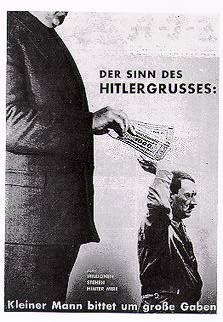 The text in the picture:
 Der Sinn des Hitlergrusses
The real meaning of the Hitler salute
Kleiner Mann bittet um grosse Gaben
The little man asks for big gifts
Millionen stehen hinter mir!
I've got millions standing behind me
Wednesday, April 9, 2008
the refrain of love
This week’s blog topic is to think about the theme of a film based on the elements we as viewers saw and heard from the film and then think about the relationship between elements and the overall feeling.
I choose Nathaniel Dorsky’s Love’s Refrain to examine this topic. What left in my memory about the film is the overall feeling of a series of dream like scenery, like the feeling given by the lomography pictures. In the past I always considered this type of film cannot be tasted by its individual pieces, meaning the film is not memorable in its particular scene but an overall sense.
However, we were asked to clarify the visual and sonic elements appear in the film before screening and thus I made myself realize the elements. The film presents one and another frames of urban scenery, natural and artificial creatures. For example, a white string pinned on the trunk of the tree and naturally let the wind blow on it. The string is blown like figurative movement. It is this type of scenes presented in the film that gives the sense of sweetness and the flow of nature. Hence, if we are defining the theme of Love’s Refrain based on what we saw and heard (scenes→overall→theme), my understanding step is:
The film is purely presenting urban sceneries → overall pleasure feeling → since the harmonious scenes we received from the nature flow into city scenes → what Dorsky’s meaning Love’s Refrain.
Thursday, April 3, 2008
.
It is interesting to link up my thoughts
One Way Boogie Woogie/27 Years Later
Randomly searching James Benning in google and i found out that i once watched these twin films in hong kong international film festival, spring 2006. i remember the uncommon title of that film, and those still images that was dreamlike but realistic, like using expired films. however i had no idea about the actual city in his film (it might/should have pointed in the film but i did not pay attention), where i would be living two years latter. It was tricky to find out.
RR
I went to watch RR the Saturday under a wish to recollect my impression from two years ago. I believe RR follows the same style as 27yrs, which is composed by couple individual frames. In each frame, one part is still and another is moving, and the fun point to watch it is the longer time you are engaged in the frame you find the stationary part and the moving part intervened. Most often the subject (train) comes into camera or leaves from camera in a diagonal line. Above the line is the sky and below it the ground. Looking at the whole image and put my focus not on the train moving in a still speed, but the sky or ground, and it makes me realized they are also moving, only in a lower speed. Put my focus not on the train but other and sometimes I would see the train as an accordion: a fixed starting point and a stretched body. Near two hours of watching trains coming and going with slightly difference added, and viewers have a refreshing feeling from the beginning to the end: I think RR proves a very matured editing of playing with still images.
Ps. Somehow I still expect a crab appears on the foreground as walking the perpendicular direction as the train walking.
Math Lecture
I find a conclusion after the lecture when watching James Benning’s fascination on math. In RR or the Boggie Woggie with blurred impression I thought there must be a sort of logic to add in his composition of the images. It is the math formula applied to construct the images, an artistic conception that is made up on formulae.
One Way Boogie Woogie/27 Years Later
Randomly searching James Benning in google and i found out that i once watched these twin films in hong kong international film festival, spring 2006. i remember the uncommon title of that film, and those still images that was dreamlike but realistic, like using expired films. however i had no idea about the actual city in his film (it might/should have pointed in the film but i did not pay attention), where i would be living two years latter. It was tricky to find out.
RR
I went to watch RR the Saturday under a wish to recollect my impression from two years ago. I believe RR follows the same style as 27yrs, which is composed by couple individual frames. In each frame, one part is still and another is moving, and the fun point to watch it is the longer time you are engaged in the frame you find the stationary part and the moving part intervened. Most often the subject (train) comes into camera or leaves from camera in a diagonal line. Above the line is the sky and below it the ground. Looking at the whole image and put my focus not on the train moving in a still speed, but the sky or ground, and it makes me realized they are also moving, only in a lower speed. Put my focus not on the train but other and sometimes I would see the train as an accordion: a fixed starting point and a stretched body. Near two hours of watching trains coming and going with slightly difference added, and viewers have a refreshing feeling from the beginning to the end: I think RR proves a very matured editing of playing with still images.
Ps. Somehow I still expect a crab appears on the foreground as walking the perpendicular direction as the train walking.
Math Lecture
I find a conclusion after the lecture when watching James Benning’s fascination on math. In RR or the Boggie Woggie with blurred impression I thought there must be a sort of logic to add in his composition of the images. It is the math formula applied to construct the images, an artistic conception that is made up on formulae.
Subscribe to:
Posts (Atom)

