Based on the portrait moly that i reported previously, i come up the conclusion of Today's art making:
***ART MAKING UNIFIES INTERNATIONAL IMAGISM***
Monday, December 1, 2008

---
There are some people like drinking coffee with milk. Without milk they do not consider coffee as COFFEE. However, when milk is forced to be taken away from their coffee, feeling might be unnatural and then they question themselves: what is the definition of coffee? Adjusting to the habit of drinking this without-milk-coffee is…


still frames
from
Song and Solitude by Nathaniel Dorsky, 2007
images are slowly presented
they are unforgettable
they are like the refrain of love
There is no either song and sound in the entire film, whereas the melody from heart rang when viewing this images.
This is my second time drawn by this landscape filmmaker’s works even looking at the single still frames from his three songs: Song and Solitude, Sarabande, and Winter. I was pleasurably engaged when sitting in the theatre and my thought at that moment was full of the positive aspects about life. I was thinking about my loved one who passed away a year ago and whispering to her, without knowing any information that the first song is that Dorsky made for his past dear friend Susan Vigil. Afterward, I questioned myself the in-depth reason that I am fond of these pieces: because they are purely pleasure to watch or because they remind me of certain profound meanings? My later conclusion declares to the first one, and the most important key for this enjoyment is its whole concentration to one aspect which is the presence of images. Hence, the images ingrain in my mind, like a significant person or melody.


still frames
from
Song and Solitude by Nathaniel Dorsky, 2007
images are slowly presented
they are unforgettable
they are like the refrain of love
There is no either song and sound in the entire film, whereas the melody from heart rang when viewing this images.
This is my second time drawn by this landscape filmmaker’s works even looking at the single still frames from his three songs: Song and Solitude, Sarabande, and Winter. I was pleasurably engaged when sitting in the theatre and my thought at that moment was full of the positive aspects about life. I was thinking about my loved one who passed away a year ago and whispering to her, without knowing any information that the first song is that Dorsky made for his past dear friend Susan Vigil. Afterward, I questioned myself the in-depth reason that I am fond of these pieces: because they are purely pleasure to watch or because they remind me of certain profound meanings? My later conclusion declares to the first one, and the most important key for this enjoyment is its whole concentration to one aspect which is the presence of images. Hence, the images ingrain in my mind, like a significant person or melody.
The style of Peter Hutton’s works are similar to style of Dorsky: the subject and the theme are bright and clear, the images are well-organized and poetic, except that I found a minimalism approach on Hutton’s work rather than pure pleasurable piece. Minimalism requires not only clean and simple footage but also imagination, and my imagination started exploded once my gaze is filled with his footage in the open and silent theatre space. Again, I think it is the silence that gets rid of the distraction, and aids the imagination to construct the minimalistic interpretation.
It is the same principle as taking milk away from coffee, Dorsky and Hutton have their soundtrack absence in their works. Somehow, the films does no longer seems like FILM as its general interpretation. Suddenly, I am enlighten by a conclusion that a silent film can be tasted similar to a poem: read it words by words, and appreciate the whole piece on the process of our association. It is a passive process, whereas I consider passivity as an elegance in literature. In Dorsky and Hutton’s films, shots are equal to words—some verb, and some adjectives—all are significantly composed and selected and the statements stand out distinctively. Perhaps this is the reason why they do not need the aid of sound to convey their meanings.
developing MOLy_X
 EXTRA EDITION! EXTRA EDITION!
As I was questioning the limitation of diversity that the Moly_X can go for, here comes the new approach of this fabulous journal! Recently, Moly_X is planning for its subcategories exploration, such as their first Moly_X_Portrait exchange (click on the image to the official blog). Sooner or later, the exchange project will have more and more specific interests and issues just like the way of an art megazine having various contents in each issue. I am eager to read this new type of Moly and report my thought about that...so here it goes:
I like this portrait drawing done by Szaza, not only because of its successful drawing but also since it especially enlightens my thought of relating the form of journal drawing to the form of media making. The “Moly way” of portrait conveys a hypothetical scene on its vivid art presences, combining authentic elements of the drawled figures and the symbolic elements such as the background of red, the circular dots of line and the pigeons. The artist uses texts to provide information about the figures on her portrait on the entry of the blog, which functioned as the "publisher" of this artifact. The lady on right is the artist herself, and the man on left is Rama, one of the members in this Moly_X_Protrait group. I intended to be snoopy and found out that Rama and Szaza are artists from different cities in USA. Szaza indicates through texts that the reference image of Rama comes from a photo of him on the envelopes that sending their Moleskines, which means that the drawing is a hypothetical scene.

Therefore, I suppose the topic of this piece is about communication between two people through the exchange of art. The image embodies the closeness between these two figures, so I suppose that they regard each other as soulmates that can inspire them to create art, even though they have never met before. I interpret all this content as a viewer who is above the “gossip” average. It is interesting to discover that these people itself have become the subject matter of the exchange event; the content of the Moly_X is the Being of Moly_X.
Tuesday, October 28, 2008
Recent Interesting Moly
 original uploaded by miwa's note
Miwa is my new discovered moly journal artist in this month. Different from many other moly journals, in her works, she partitions off her dairy in four parts and each part as a scene portraied by graphic illustration and text. Like the above dairy, October 5th, she simply documented four things:
--watched a jp movie under patience
--ate instant rice meal
--sleep
--romantic idea about going to india
The common thoughts are presented like a 4-koma which makes the
ordinary routine has the degree of narrative. On the aspect of graphic interpretation, she draw the layout of Indian elements according to her momentary mind-travel to India. Besides, when putting her handmade journal onto flickr, she added notes of link sources to support her text about some understandings of japanese cultures.
The function of flickr has so many aspect that waiting for user to explore:)
Once again I was intrigued to this image since the joy to read life in another culture, such as the japanese instant rice that "can get it in the nearest convenience store". But also I am reminded to connect trivia to art. I can definitely recall four interesting things happened in Octo 5th by looking at my agenda, calendar, blog, facebook status, course syllable etc, but I have never intended to magnify them.
most interesting Mole_X
although there is no much relation to film and experimental media, i hope to share this my favorite moly journal on flickr.

As a viewer, i see a symphony of jungle that I almost create a myth from the detailed elements in this image.my mind was full of imaginations after I found out the artist Mrty lives in Minnesota and I assum that the northe side of Minnesota, Ely or Duluth is his inspiration of the forest in his drawings. I subjectively remember Duluth, Minnesota in the way this image portrays. In fact, not only this journal does this effect to me, but all other molys which impress viewers of objects and places in their unique presences.
Russian doll, German beer, Tokyo transit map, planetarium,sparrow, toblerone, receipe illustration, new PsP, new jewleries or boyfriend's new haircut...
Russian doll, German beer, Tokyo transit map, planetarium,sparrow, toblerone, receipe illustration, new PsP, new jewleries or boyfriend's new haircut...
Monday, October 27, 2008
INST1 Boundary Functions by Scott Snibbe
 I was engaged by the Scott Snibbe's Boundary Functions. This work is perhaps not the most fun one to act and have most fascinated reaction among others of the exhibition, but the message that this simple act stands for works profoundly well with the action.
In my experience, the message of solitude within the society is revealed through the notice of the transparent platform that reflects our shadow: as we walk within our own boundary created by the line, we are with no one but the reflection of our individuality from the platform. This metaphor is clearer when I look at the above image i accidentally took as I was standing on the other side of the platform: the son was partitioned from his father by the diagram. He looked at where his father stands and noticed the message from his father: in the society the only one can assist him is not his father but himself.
Snibbe's Boundary Functions embodies an interaction that is: it retains the principle of passive art, which is that "we do not change them but they certainly at its best, influence us" and change us, as George Fifield indicated. Nonetheless, there is a difference among the ways that how every audience receive the message. Me, for instance, i firstly saw a top-full view of Functions and see the message through the clear voroni diagram, but when I was present in there I received the message through the reflection of other participants. Therefore, the innovation from passive art to Functions is embodied at: it transit one simple but profound message and it provides a wide range of possibility to let its audiences control the way they reiceive it.
Snibbe's Boundary Functions embodies an interaction that is: it retains the principle of passive art, which is that "we do not change them but they certainly at its best, influence us" and change us, as George Fifield indicated. Nonetheless, there is a difference among the ways that how every audience receive the message. Me, for instance, i firstly saw a top-full view of Functions and see the message through the clear voroni diagram, but when I was present in there I received the message through the reflection of other participants. Therefore, the innovation from passive art to Functions is embodied at: it transit one simple but profound message and it provides a wide range of possibility to let its audiences control the way they reiceive it.

ACT/REACT
 aka interactive art
Act: the artist and the installation
React: body of viewers Medium: Space
ACT+MEDIUM+REACT
==infinitive chemistry
distorting mirror's physic principle has been replaced by video technology, whereas joy is twofold.
React: body of viewers Medium: Space
ACT+MEDIUM+REACT
==infinitive chemistry
distorting mirror's physic principle has been replaced by video technology, whereas joy is twofold.
Sunday, October 26, 2008
I am reporting the journal of MOLESKINE
 Moleskine Exchange is a very popular activity for people who still has the habit to handwritten and draw journal. It is taken place on flickr and Blogger, and every corner of the world.
brief explanation: Artists from all over the world encountered in flickr, the MOLE_X international exchange group, and found their members around the world. Once a confirm of six members, they establish a blog followed by their Mole's number. (example: look at Mole_1). They make one journal on a japanese fold moleskine  notebook (about a memo size), and send the notebook to the next member in their mole group. Members are chosen from different country on the earth as this entry by artist Kathirn illustrated
notebook (about a memo size), and send the notebook to the next member in their mole group. Members are chosen from different country on the earth as this entry by artist Kathirn illustrated
Flickr is the collected image pool where they scan the journal they received, and they use Bloggerto annouce and give feedback.
the experience that my encounter of this group is due to movie. I was looking for screened images of the movie The Darjeeing Limited on flickr, and I found this entry by one moly_x illustrator from Germany. This collaboration of dairy and illustration and movie image compelled me. I followed the “set” of Moleskine in this artist’s photostream and finally traced to the Moly_X foundation. I joint this foundation although I still have no courage to ask for a new round runner (today Moly exchange has up to round 60). However, I became a big fan of the moly entries they made.Plenty of the journal are intriguing to both be read as story and be viewed as artwork. This is perhaps because of the diversity of their lives from so many places, and the diversity of the way they interact their everyday life with art, and most specially, condensed in this small size of actual notebook.
Thursday, October 23, 2008
I Know Where the Summer Goes
 I Know Where the Summer Goes
by Ryan McGinley
for the rest of images in this series check out TINYVICES
the human body texture interviewing with the magic color under lens illustrate the artistic value of their works. Whereas the interpretation of the images in Schneemann's fuses and McGinley's series is bipolar, which leads to a bipolar reaction to each piece. The message transmitted in Summer is the closeness between human and nature. The figures in McGinley's photographs are crude, illuminated, and perfectly sweet and happy. The organic elements pictured on their body such as the firework twinkle and the wheatfield undulate in the breeze makes me as a viewer think of youthood: at that age we had nothing but joy and time, time to be alone and wait for becoming adult, which is a bittersweet age.
Tuesday, September 30, 2008
9/28
I went to the
Shore’s major series is presented in 8x10 large prints and vivid color: the images trace down his journey around the lands of
Last but not the least I would associate Shore’s works with Paul Chan’s journey to
Monday, September 29, 2008
Stephen Shore says: imagery is the bridge to access reality
 现实是作为一个平面的影象反映在相纸上,我要创作的影象是,看上去是平面的,同时又是三维的幻觉。
The reality reflects on the paper as a flat image, and the image I want to create is not only flat but meanwhile has the illusion of three dimensional.
4、你是从纷繁复杂的世界入手,你一旦取景,便对你所看到的世界进行组织,某种意义上来说也是使得它更加简洁。
5、我在拍摄中所感兴趣的一件事情是,如何在一种高度强化的意识境界中传达世界的形象。我自认为最能做到这一点的是通过最普通的场景来传达。
6、而台灯更难拍,因为台灯是如此平凡,以至于你必须特别注意周围的世界才能注意到它。
7、我认为,一个好的摄影家是两方面的结合体:一方面是具备有趣的感受,另一方面是理解这个世界如何能通过相机转变成照片。
8、作为摄影家,我所要拍摄的是表象,但事物的表象是各种深层力量的迹象。
 A quote that I like very much... comes close to explaining my attitude about taking photographs.... "Chinese poetry rarely trespasses beyond the bounds of actuality... the great Chinese poets accept the world exactly as they find it in all its terms and with profound simplicity... they seldom talk about one thing in terms of another; but are able enough and sure enough as artists to make the ultimately exact terms become the beautiful terms."
 excerpt from an interview of Shore and the Chinese Photography magazine:)

Thursday, May 1, 2008
....
About The Ways Things Go: as a viewer I from the beginning was attracted by the chain reactions that is used by trash materials. I was intrigued to be following by the moving object in the film. I think in this kind of spectatorship it resembles what a narrative offers. Following this spectatorship angle I start sketching the whole film as a story: there is always a moving object—although it is not the same one it is always only a single object performing, and he is the protagonist in a narrative which allows us to reveal the world around him. The world is not exactly around him, but either in front of or behind him. This also provides a non-conventional narration style, which is to portrait the protagonist in a solitary space. Besides, each of his action provides one thought to viewers. Thus after viewing more than ten actions viewers choose to clarify each thought, to associate them together, or to individually think of them, and this kind of “free association/digestion” for viewers is what the narrative cannot functions.
Thursday, April 24, 2008
Report
REPORT:
The film title tells about Bruce Conner's intention to deceive his audience that the film would be a documentary-like presentation. In fact, the film is a presentation of a report only in Conner's personal logical world. The elements he composes his "report" of the president's assassination included the newsreel footage, the reporter sound and a large range of indirectly relevant material that has to be associated in audiences' minds. With the association of these montage presences, Report on one hand mythologizes the tragic event; on the other hand Conner implies a deeper understanding of politic characteristic the relationship between politic and other issues, such as media and consumerism. This film has an extremely rich sense of intervention, and so I can only choose a few points to elaborate it.
-The presence of matador. As we see the matador is going towards the bull the sound we heard is describing the security precaution for the president. The next scene shows the matador killed the bull, but the presence of president's assassination is absent. The intercutting between these two situations seems purposing a suspicion about the real murder of this assassination.
-The bulb’s breaking. The bulb is not shown in breaking at once, but is shown in slow motion in three or four times, which symbolize the heartbreaking tragedy happened in a moment, but it is slowly taking its affliction. What can be more symbolic is the absence of soundtrack when showing the bulb’s breaking image.
-The final “sell” bottom: This assassination has been presented in media countlessly, and in my thought it is pathetic to overly reenact this tragedy no matter in what aspect. The word “sell”, thus, in my understanding it represents the commercialization that the public does to this tragedy. It has become a valuable commercial product, and even it is a report presentation. Thus, the Conner “report” ends in this image. The “report” is completed.
The film title tells about Bruce Conner's intention to deceive his audience that the film would be a documentary-like presentation. In fact, the film is a presentation of a report only in Conner's personal logical world. The elements he composes his "report" of the president's assassination included the newsreel footage, the reporter sound and a large range of indirectly relevant material that has to be associated in audiences' minds. With the association of these montage presences, Report on one hand mythologizes the tragic event; on the other hand Conner implies a deeper understanding of politic characteristic the relationship between politic and other issues, such as media and consumerism. This film has an extremely rich sense of intervention, and so I can only choose a few points to elaborate it.
-The presence of matador. As we see the matador is going towards the bull the sound we heard is describing the security precaution for the president. The next scene shows the matador killed the bull, but the presence of president's assassination is absent. The intercutting between these two situations seems purposing a suspicion about the real murder of this assassination.
-The bulb’s breaking. The bulb is not shown in breaking at once, but is shown in slow motion in three or four times, which symbolize the heartbreaking tragedy happened in a moment, but it is slowly taking its affliction. What can be more symbolic is the absence of soundtrack when showing the bulb’s breaking image.
-The final “sell” bottom: This assassination has been presented in media countlessly, and in my thought it is pathetic to overly reenact this tragedy no matter in what aspect. The word “sell”, thus, in my understanding it represents the commercialization that the public does to this tragedy. It has become a valuable commercial product, and even it is a report presentation. Thus, the Conner “report” ends in this image. The “report” is completed.
Friday, April 18, 2008
Photomontage
John Heartfield, the pioneer of photomontage, develop this unique method of approprating and reusing photographs to powerful political effect. Photomontage uses a large quantity of similar or contradicted images and films, by cutting and pasting them and reorganized and mounting them to composed a finished image with an extraordinary logical meaning. These images are usually carry an exaggerative characteristic, therefore they became a product to advocate revolutionary art. Heartfield uses method to create a series of ironic Nazism images. The photomontage in Heartfield's practice, become a form of mass communication.
 The text in the picture:
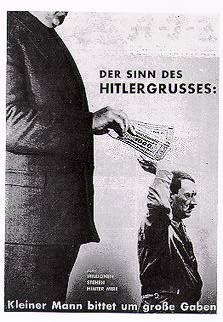 The text in the picture:
 Der Sinn des Hitlergrusses
The real meaning of the Hitler salute
Kleiner Mann bittet um grosse Gaben
The little man asks for big gifts
Millionen stehen hinter mir!
I've got millions standing behind me
Wednesday, April 9, 2008
the refrain of love
This week’s blog topic is to think about the theme of a film based on the elements we as viewers saw and heard from the film and then think about the relationship between elements and the overall feeling.
I choose Nathaniel Dorsky’s Love’s Refrain to examine this topic. What left in my memory about the film is the overall feeling of a series of dream like scenery, like the feeling given by the lomography pictures. In the past I always considered this type of film cannot be tasted by its individual pieces, meaning the film is not memorable in its particular scene but an overall sense.
However, we were asked to clarify the visual and sonic elements appear in the film before screening and thus I made myself realize the elements. The film presents one and another frames of urban scenery, natural and artificial creatures. For example, a white string pinned on the trunk of the tree and naturally let the wind blow on it. The string is blown like figurative movement. It is this type of scenes presented in the film that gives the sense of sweetness and the flow of nature. Hence, if we are defining the theme of Love’s Refrain based on what we saw and heard (scenes→overall→theme), my understanding step is:
The film is purely presenting urban sceneries → overall pleasure feeling → since the harmonious scenes we received from the nature flow into city scenes → what Dorsky’s meaning Love’s Refrain.
Thursday, April 3, 2008
.
It is interesting to link up my thoughts
One Way Boogie Woogie/27 Years Later
Randomly searching James Benning in google and i found out that i once watched these twin films in hong kong international film festival, spring 2006. i remember the uncommon title of that film, and those still images that was dreamlike but realistic, like using expired films. however i had no idea about the actual city in his film (it might/should have pointed in the film but i did not pay attention), where i would be living two years latter. It was tricky to find out.
RR
I went to watch RR the Saturday under a wish to recollect my impression from two years ago. I believe RR follows the same style as 27yrs, which is composed by couple individual frames. In each frame, one part is still and another is moving, and the fun point to watch it is the longer time you are engaged in the frame you find the stationary part and the moving part intervened. Most often the subject (train) comes into camera or leaves from camera in a diagonal line. Above the line is the sky and below it the ground. Looking at the whole image and put my focus not on the train moving in a still speed, but the sky or ground, and it makes me realized they are also moving, only in a lower speed. Put my focus not on the train but other and sometimes I would see the train as an accordion: a fixed starting point and a stretched body. Near two hours of watching trains coming and going with slightly difference added, and viewers have a refreshing feeling from the beginning to the end: I think RR proves a very matured editing of playing with still images.
Ps. Somehow I still expect a crab appears on the foreground as walking the perpendicular direction as the train walking.
Math Lecture
I find a conclusion after the lecture when watching James Benning’s fascination on math. In RR or the Boggie Woggie with blurred impression I thought there must be a sort of logic to add in his composition of the images. It is the math formula applied to construct the images, an artistic conception that is made up on formulae.
One Way Boogie Woogie/27 Years Later
Randomly searching James Benning in google and i found out that i once watched these twin films in hong kong international film festival, spring 2006. i remember the uncommon title of that film, and those still images that was dreamlike but realistic, like using expired films. however i had no idea about the actual city in his film (it might/should have pointed in the film but i did not pay attention), where i would be living two years latter. It was tricky to find out.
RR
I went to watch RR the Saturday under a wish to recollect my impression from two years ago. I believe RR follows the same style as 27yrs, which is composed by couple individual frames. In each frame, one part is still and another is moving, and the fun point to watch it is the longer time you are engaged in the frame you find the stationary part and the moving part intervened. Most often the subject (train) comes into camera or leaves from camera in a diagonal line. Above the line is the sky and below it the ground. Looking at the whole image and put my focus not on the train moving in a still speed, but the sky or ground, and it makes me realized they are also moving, only in a lower speed. Put my focus not on the train but other and sometimes I would see the train as an accordion: a fixed starting point and a stretched body. Near two hours of watching trains coming and going with slightly difference added, and viewers have a refreshing feeling from the beginning to the end: I think RR proves a very matured editing of playing with still images.
Ps. Somehow I still expect a crab appears on the foreground as walking the perpendicular direction as the train walking.
Math Lecture
I find a conclusion after the lecture when watching James Benning’s fascination on math. In RR or the Boggie Woggie with blurred impression I thought there must be a sort of logic to add in his composition of the images. It is the math formula applied to construct the images, an artistic conception that is made up on formulae.
Thursday, March 27, 2008
The Spiral Jetty
In the near ending part of the film it shows Robert Smithson running starts from the edge of spiral to the center. When he stops at the central dot the camera from the helicopter zoom further and further. The shape of spiral becomes more and more visible. This is the most striking moment in the film for me but it perplexed me as well that the intention for this movement.
After I read the text about Robert Smithson and his work as land art I have built up my interpretation of this scene. The essential goal of land art is to treat a landscape as an artwork, likewise to make people see artwork as close like the nature. However, the nature has its characteristic of solitariness, which even makes the artist himself feel the inaccessibility. In this scene the artist is shot gradually minor, until surrounded by he black lava. The sense of solitary, depress, flow and stillness is presented and thus, PERHAPS to support his question towards it.
However, at the same time I found this quote from an article in R.S’s official website:
"No ideas, no concepts, no systems, no
structures, no abstractions could hold themselves together in the actuality
of that evidence"
 the other way to make site transform into nonsite is: to get a tatoo one one's skin:p
After I read the text about Robert Smithson and his work as land art I have built up my interpretation of this scene. The essential goal of land art is to treat a landscape as an artwork, likewise to make people see artwork as close like the nature. However, the nature has its characteristic of solitariness, which even makes the artist himself feel the inaccessibility. In this scene the artist is shot gradually minor, until surrounded by he black lava. The sense of solitary, depress, flow and stillness is presented and thus, PERHAPS to support his question towards it.
However, at the same time I found this quote from an article in R.S’s official website:
"No ideas, no concepts, no systems, no
structures, no abstractions could hold themselves together in the actuality
of that evidence"
 the other way to make site transform into nonsite is: to get a tatoo one one's skin:p
Friday, March 14, 2008
2:30 video
My table top project aims to present an artificial scenes about penguins in Antarctica, in order to present the pleasant time of the lovely creatures remains not too much since the global warming problem is threatening Antarctica. By presenting this image I would use my fingers as a group of skinny penguins, and “they” act as playing piano as if the penguin dancing. This is the first moving part, and under the penguins there is a stripe of slowly moving images symbolizing the icy environment the penguins live which is the second moving part. This idea of playing on a moving plane form came from the slang “playing a new chapter”. I would also present a background music giving the rhythm to how my fingers move. The music is a reproduction of a song called “to the dancer on the ice” by Emilie Simon.
Ideally, the two and a half minutes would be divided by three parts:
- Fingers covered by a black glove, a series of images along with the music activate the fingers’ act.
- *A transition from the glove to the “penguins” presence, which is a keyboard drawn into the shot. The melody here is also added with drum sound and etc.
- Another stripe images. Same movement as the first part except for the fingers replace the glove.
Introspection of the performance:
There are couple incidents happened and made the performance become hilarious which I should introspect.
- With the help of two peers the images was moving ideally. One of the picture was not pasted very tight and it draw my attention to it. Thus at the time when the messy picture go into the camera my finger was acting not naturally and completely distract by the image. This should be avoided by the more careful preparation.
- On the *part the performance went to a bit lost control. I took off the glove on time, however I played the transition piece on the keyboard ridiculously. One hilarious mistake was happen that I press the wrong keyboard tone(raindrop tone became robot tone ), so there were a few blizzard sound would be heard on that part.
- At the end there was supposed to be a colorized “Victoria frog” across the image, to present to extinction of the gray Antarctica creatures in terms of the others. However, I forgot the frog completely.
The time count between images movement and music, the fingers presented as penguins went successfully.
Overall, I think the problems such as piano piece, fingers acting…could be easily avoid due to more actual practices. Besides, I still sees my over-complication to a 2:30 minutes performance. To reduce one or two elements from the whole, such as the music transition or the fingers transition, might work better than here.
Tuesday, February 26, 2008
.
The discussion about the identification of author, authorship, responder, artist, participant, viewer, and the destabilization among them is arouse in this week’s lecture. We watched short film such as Neil Goldberg’s My parents to see the role between the director and the performer, we listened a song originated from 70s rock band and re-performed by Langley school kids, and what I found the most compelling is the LearningToLoveYouMore project.
To use LTLYM as an example to reveal the issue of destabilization, the boundaries between artist and viewer is blur. the project directors Fletcher and July encourage everyone to practice art related to their daily simplicity and themselves. Yet this blurred line is not a leading to an vague attitude or an appreciation to anything. LTLYM is introduced as “an assignment art/project” and the word assignment carries a sense of responsibility, and this responsibility by completing the art with fidelity should be carried by both the project founders and the ones who take the tasks. Like what is concluded in Julia Bryan-Wilsons’s article, Fletcher and July encourage people to make specific objects, offering assignments with concrete parameters and rigorous guidelines. The instruction for every assignment is strictly exists.
For Fletcher and July, they are who offer the idea of the assignment, and offer the imaginary spaces for the participant to practice their ideas with their own imagination. By this process they are demonstrating the unique from everyone’s practice, which also means they are demonstrating that they are completely not the controller although they invents the instruction, since imagination is always out of control.
Friday, February 22, 2008
Comments
On this week's lecture we listened the speech given by a Canadian artist, and her works revealed a discussion of the boundaries between sincerity and humorous at the group discussion. It is indeed exist the risk that one's sincerity might be understand as a sense of naïve and thus humorous, and it is true that every viewers has its own perspective towards an artwork. Among all the films Thauberger showed at the lecture, I found the first one Not Afraid to Die is the most interesting one. It first depicts a girl alternatively waiting and the shot is static, then a slightly change is she begins to snack and drink water. Immediately following her movement the sound changes from birds to airplane. I found that the artist’s intention is showing the sound’s changing in terms of the static scene, and thus demonstrates that one figure’s look can be perceived different by the sound atmosphere. It is even tends to a trick film’s effect. Nevertheless, I found my viewpoint was not what the artist analyzes her work, which she is depicting some spiritual voice that the girl heard.
The last film Northern shown by the artist is about Canadian treeplanters. The film plot is inspired by the notable painting The Raft of the ‘Medusa’, also intends to present the environment damaged scene and related to human being. The artist mentions that the country is where Brokeback Mountatin is filmed, and it reminds me of the nature presented in that film: the director of BBM once talked about how the scene should be shot in low angle in order to involve air, and how air and trees can create the sound of the wind and melted into the characters’ motion. Since I was very impressed by his using of nature in BBM, I expected to perceive more interactions between the nature and the people in Thauberger’s Northern.
The last film Northern shown by the artist is about Canadian treeplanters. The film plot is inspired by the notable painting The Raft of the ‘Medusa’, also intends to present the environment damaged scene and related to human being. The artist mentions that the country is where Brokeback Mountatin is filmed, and it reminds me of the nature presented in that film: the director of BBM once talked about how the scene should be shot in low angle in order to involve air, and how air and trees can create the sound of the wind and melted into the characters’ motion. Since I was very impressed by his using of nature in BBM, I expected to perceive more interactions between the nature and the people in Thauberger’s Northern.
Friday, February 15, 2008
On the other end of calm
Emma W-W’s short video about Tate Modern: The performer has indeed a motion of exasperation, whereas there is a sense of balance in his annotation between calmness and anger that makes me moved as a viewer. He chooses to say with oral word, but not giving a direct vernacular speech. Why? Maybe it is because to annotate an issue about black and white via giving a vernacular speech: how similarly remind viewers of lyrics in 2pac’s songs or American History X? However, when viewers encounter those oral words appearing lines in line on the screen and along with a quite face, the emotion is thus magically presented, beyond that when we only see the words or the still face.
I think this can also exemplify the fascination of deadpan: to use a flat and expressionless face to serve a stereoscopic function, and to transmit a weighted message. And thus I think, EWW’s video illustrated that, deadpan is able to apply on various genre but not only comedy. A face of deadpan is not only applied the function of pleasure, it could also be anger. On the other end of flatness is extravaganza. However, it could probably be another end for it, which is exasperation.
Tuesday, January 29, 2008
Week 1-Miranda July's The Amateurist
When watching The Amateurist by Miranda July, it is easy to notice that the movie addresses an issue of communication between two figures.
The Amateurist depicts a woman, recognized as the professional, observes another woman on a surveillance camera and describes her actions, with no other interaction between them. The interaction can be seen as “unidirectional” here: only one can observe the other. Through the context given by the professional woman, a “both-way interaction” is seems created: by ordering the numbers that the amateurist woman can posture…the body languages are manifested by her: the woman in the limited space and such performance seems like a reaction to the person in another space. The interaction in The Amateurist is obscure and it is one thing that July intends to blur the potentialities.
The Amateurist depicts a woman, recognized as the professional, observes another woman on a surveillance camera and describes her actions, with no other interaction between them. The interaction can be seen as “unidirectional” here: only one can observe the other. Through the context given by the professional woman, a “both-way interaction” is seems created: by ordering the numbers that the amateurist woman can posture…the body languages are manifested by her: the woman in the limited space and such performance seems like a reaction to the person in another space. The interaction in The Amateurist is obscure and it is one thing that July intends to blur the potentialities.
Subscribe to:
Posts (Atom)

